

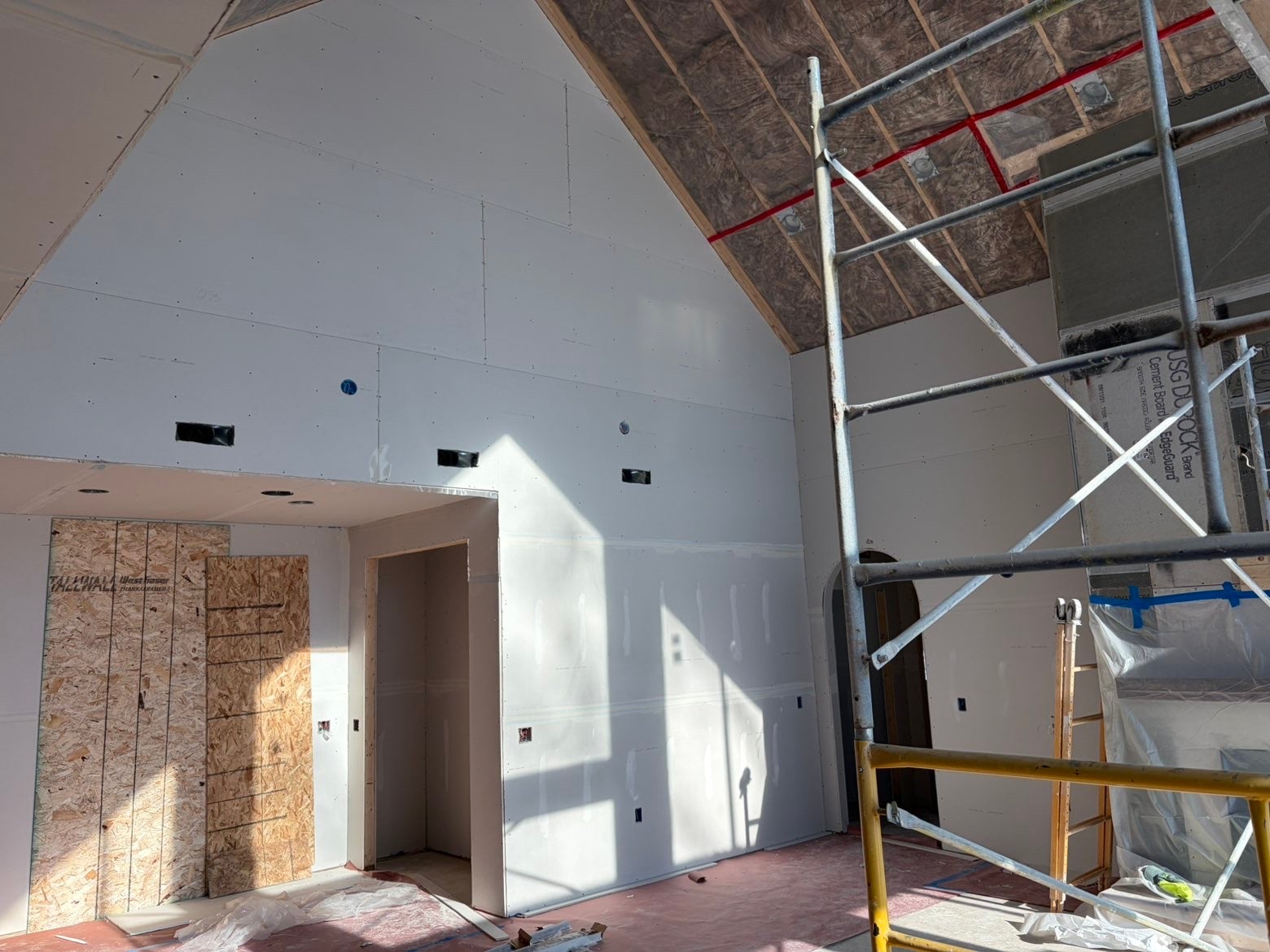
Basement Finishing Drywall Cost in Wisconsin: Egress, Permits & Moisture-Safe Assemblies
The short answer
The drywall portion of finishing a basement in the Madison area runs roughly $3,500–$8,000 (estimated) for a typical 800–1,200 sq ft space, depending on ceiling height, room count, and finish level. Moisture-resistant board adds about 15–20% to material cost but protects below-grade walls.
On this page
- Cost calculator
- How much does basement finishing drywall cost in Wisconsin?
- What kind of drywall should you use in a Wisconsin basement?
- Do you need a permit and an egress window to finish a basement in Madison?
- What finish level should a basement get, and why does it change the price?
- What's included in a basement drywall estimate vs. the whole finished-basement budget?
- Frequently asked questions
Estimate your basement drywall cost
Enter your room size for an instant estimate.
Includes: hanging, taping, mud, and sanding to a Level 4 finish. Drywall scope only — a standard 800–1,200 sq ft basement runs roughly $3,500–$8,000. Moisture-resistant board for below-grade walls adds about 15–20% on materials. Framing, electrical, flooring, and paint are priced separately. Room mode assumes 8 ft ceilings (4 walls + ceiling).
Estimates for the Madison & Dane County market — every project is priced individually. The only firm number is a free written estimate.
How much does basement finishing drywall cost in Wisconsin?
In the Madison and Dane County area, the drywall portion of finishing a basement typically costs roughly $3,500–$8,000 (estimated) for a standard 800–1,200 sq ft of wall and ceiling area. That estimate covers hanging, taping, mudding, and sanding to a paint-ready Level 4 finish — it does not include framing, insulation, electrical, plumbing, flooring, or paint, which are separate line items in a full basement project.
What moves the number inside that range is straightforward: ceiling height (many older Madison basements near the isthmus and in neighborhoods like Marquette or Tenney-Lapham have low, uneven heights that take more cutting and trimming), the number of separate rooms and closets, how many bulkheads and soffits hide ductwork and plumbing, and the finish level you choose. A single open rec room finishes faster and cheaper per square foot than the same footage chopped into a bedroom, bath, and storage area.
Drywall is usually one of the larger trade line items, but it is rarely the whole basement budget. For overall installation context, our drywall installation runs about $1.50–$3.50 per square foot (materials and labor, estimated), and basement work tends to sit toward the middle-to-upper part of that band because of moisture-resistant board, more inside corners, and the framing complexity below grade. We provide a free written estimate, usually within 24 hours, so you get a real number instead of a guess.
Basement drywall cost in Wisconsin (2026)
- $3,500–$8,000
- Standard basement
- $1.50–$3.50
- Per square foot
- +15–20%
- Moisture-resistant board
- Level 4
- Standard finish
drywall scope, 800–1,200 sq ft
materials + labor
below-grade walls
paint-ready
Estimates for the Madison & Dane County area; drywall scope only.
What kind of drywall should you use in a Wisconsin basement?
For a Wisconsin basement, use moisture-resistant drywall (commonly green board) on below-grade walls, and consider mold-resistant board (purple board) in areas prone to dampness — never standard white drywall pressed straight against a cold foundation. Below-grade walls stay cool year-round, and our humid Wisconsin summers push warm, moist air into the basement, where it can condense on those cool surfaces. The right board, hung as part of the right wall assembly, is what keeps a finished basement looking good a decade later.
Just as important as the board is what is behind it. A durable basement wall is an assembly: continuous rigid foam or a proper framed-and-insulated wall holds the drywall off the cold concrete, a managed air and moisture gap prevents condensation, and the drywall is kept up off the slab a small amount rather than wicking water from the floor. We coordinate our hanging and finishing around that assembly so the moisture control your builder or insulation contractor designed actually does its job.
Madison's housing stock matters here. Mid-century ranches in places like Monona and Madison's older east and west sides, and lake-adjacent homes near Lake Waubesa or Lake Wingra, often have basements that have seen seasonal humidity for decades. We assess the existing conditions before we hang a single board, and if we see active water intrusion or efflorescence, we will tell you to address it first — drywall covers a wall, it does not fix a leak.
- Moisture-resistant (green board) — standard choice for below-grade basement walls
- Mold-resistant (purple board) — extra protection for damper basements and bathroom areas
- Standard drywall — acceptable only for upper, dry, well-ventilated areas like an interior partition away from the foundation
- Keep the bottom edge held up off the slab so the board never wicks water from the floor
Do you need a permit and an egress window to finish a basement in Madison?
Generally, yes — finishing a basement in the Madison area requires a building permit, and any new bedroom in the basement requires a code-compliant egress window or door for emergency escape. Permits exist so the work meets requirements for egress, fire separation, insulation, electrical, and plumbing. We are a drywall contractor and not a code authority, so treat this as general guidance and confirm the specifics with your local building department (the AHJ — authority having jurisdiction) or your general contractor before you build.
Egress matters for drywall because the rough opening, window well, and surrounding framing all need to be in place and inspected before walls get closed up. An egress window enlargement is a real excavation and concrete-cutting job, not a drywall task — but we finish cleanly around the new opening once it is framed, so the wall looks intentional rather than patched. If your plan adds a basement bedroom, sort out egress early; it is far cheaper to plan for than to retrofit after the walls are up.
Inspection sequencing is the practical reason permits affect your timeline. Framing, electrical, and insulation are typically inspected before drywall goes up, because once boards cover the wall, the inspector can no longer see what is behind them. We schedule our hanging to land after those rough-in inspections pass, which keeps the project moving and avoids the expensive mistake of having to cut open finished walls.
What finish level should a basement get, and why does it change the price?
Most finished basements get a Level 4 finish, which is the standard for walls and ceilings that will take flat or eggshell paint, and it is what we recommend for the majority of basement rec rooms, bedrooms, and offices. Level 3 is a coarser finish meant to live under heavy texture, and Level 5 is a premium, glass-smooth finish for gloss paint or areas raked by strong light. The level you pick directly affects labor hours, which is why it moves the price.
In a basement, lighting drives the decision. If you are installing lots of can lights or a big egress window that throws raking light across a long wall, small imperfections show, and a Level 5 finish or a light texture can be worth it on those feature walls. For a typical basement with softer, even lighting, a well-executed Level 4 looks clean and keeps cost in check. We will walk the space with you and recommend level by area rather than over-finishing the whole basement.
Texture is the other lever. A light knockdown or orange-peel texture over a Level 3 base hides minor variation and can finish faster than chasing a flawless smooth wall, which some homeowners prefer for a casual basement. Our finishing and texture crews are in-house — no subcontractors — so the same standard carries from the first coat of mud to the last pass of the sander.
What's included in a basement drywall estimate vs. the whole finished-basement budget?
A basement drywall estimate from us covers the drywall scope: moisture-resistant board where the assembly calls for it, hanging on walls and ceilings, all taping and mudding, sanding to your chosen finish level, corner bead, and finishing around bulkheads, soffits, and the egress opening. The whole finished-basement budget is larger because it also includes framing, insulation and vapor management, electrical, plumbing, HVAC adjustments, flooring, trim, doors, and paint — trades we coordinate with but that are priced separately.
This distinction is where homeowners get surprised, so we are upfront about it. When you compare quotes, make sure you are comparing the same scope: a low 'basement drywall' number that quietly excludes the ceiling, or assumes standard board against the foundation, is not really cheaper. Our written estimate spells out board type, square footage, finish level, and what is and is not included, so there are no gaps later.
We work as the drywall specialists alongside your general contractor, or directly with homeowners managing their own project, and we serve Madison, Sun Prairie, Middleton, Fitchburg, Verona, and the surrounding Dane County communities. Reach us at (608) 228-9276 or samaniegodrywall.com for a free written estimate, usually back to you within 24 hours, in English or Spanish.
| Project / factor | Typical estimated range | What's included / notes |
|---|---|---|
| Standard basement (800–1,200 sq ft wall + ceiling area) | $3,500–$8,000 | Hang, tape, mud, sand to Level 4; moisture-resistant board where below grade |
| Open rec room (single large space) | Lower end of range | Fewer inside corners and closets; faster per sq ft |
| Multi-room finish (bedroom + bath + storage) | Upper end of range | More corners, soffits, and a moisture-area bathroom assembly |
| Moisture-resistant board upcharge | +15–20% on materials | Green/purple board vs. standard white drywall for below-grade walls |
| Finish level upgrade (Level 4 to Level 5) | Added labor | Premium smooth finish for gloss paint or raking light on feature walls |
| General installation reference (any room) | $1.50–$3.50 / sq ft | Materials + labor; basement work trends mid-to-upper due to board + complexity |
Frequently asked questions
Is the drywall the most expensive part of finishing a basement?
Can you drywall a basement that has had water issues in the past?
Do I have to drywall my basement ceiling, or can I leave it open?
Why does basement drywall sometimes cost more per square foot than an upstairs room?
Do you handle egress window cutouts, or just the drywall around them?
Related services
Want a real number for your project?
We give free, written estimates across Madison and Dane County — usually within 24 hours.